
Medically reviewed by: Dr. Marc Serota & the physician team at MDI — Velora Wellness Physician Network
Turn the search term into a treatment question
The phrase “weight loss pill” names a search category, not a prescription. It can point you toward an oral medication, but a clinician may also discuss an injectable treatment when comparing weight-management options. Guidance on medication selection includes the form—pill or injection—along with dosing frequency, possible interactions, side effects, expected effect, and cost. The more useful question is: Which treatment forms should you discuss, and how would each fit your health information, preferences, access, and budget?
Medication names alone cannot answer that question. A Canadian guideline lists several long-term medications, but that list reflects Canadian jurisdiction and should not be treated as a current United States approval or labeling list. A United States clinical standard also notes that most medication options have not been compared in direct head-to-head trials, while your response can vary with the medication, your overall health, and other factors. Use search results to identify topics for discussion, not to skip clinician review.
A sensible decision path has four stages:
- Define the goal. Decide whether you are seeking weight change, improvement in a related health concern, or both.
- Describe your circumstances. Include current medicines, allergies, pregnancy or breastfeeding status, relevant conditions, prior treatment experience, and your preferred route.
- Compare the options using the same criteria. Review expected effect, safety, suitability, administration, access, cost, and follow-up together.
- Choose the next conversation. Bring the comparison to a qualified clinician who can determine whether a prescription belongs in your care plan.
This approach keeps the search term useful without turning it into a self-directed treatment decision.
Why a single best medication does not exist
A single best medication does not exist for every person because the evidence and your circumstances vary. A clinical standard places medications in a relative order of expected benefit, yet notes that most have not been directly compared and that responses can differ. Another clinical source explains that your response can depend on the medication, your overall health, and other individual factors. A ranking can describe an average or expected pattern; it cannot predict your result or decide whether treatment suits you.
The American Gastroenterological Association gives a qualified recommendation rather than a universal prescription. For adults who meet its clinical criteria—those with a recognized weight-related condition or related complications after an inadequate response to lifestyle interventions—the guideline recommends adding medication to lifestyle interventions rather than continuing lifestyle interventions alone. The same guideline suggests semaglutide 2.4 mg alongside lifestyle modifications for eligible adults and says that it may be prioritized for many eligible patients because of its net benefit. Those statements apply within the guideline’s clinical conditions; they do not establish that semaglutide is appropriate for you.
Medication choice also involves trade-offs that a headline ranking cannot show. The AGA says selection may depend on your clinical profile, related conditions, preferences, cost, and access, and treatment may need to continue long term. The Canadian guideline adds side effects, medication interactions, form, dosing frequency, and expected effect to the discussion. A route that suits your daily routine may not suit your health circumstances, and a medication that appears attractive on expected effect may be difficult to access or continue. Compare the whole treatment pathway, not a single result.
Start with form, frequency, and routine
A route-first method starts with form, dosing frequency, and routine fit when you compare oral and injectable options. It then directs attention to practical questions about preferences, access, and cost. Discuss the route, dosing frequency, interactions, related health conditions, preferences, cost, and access with a healthcare professional.
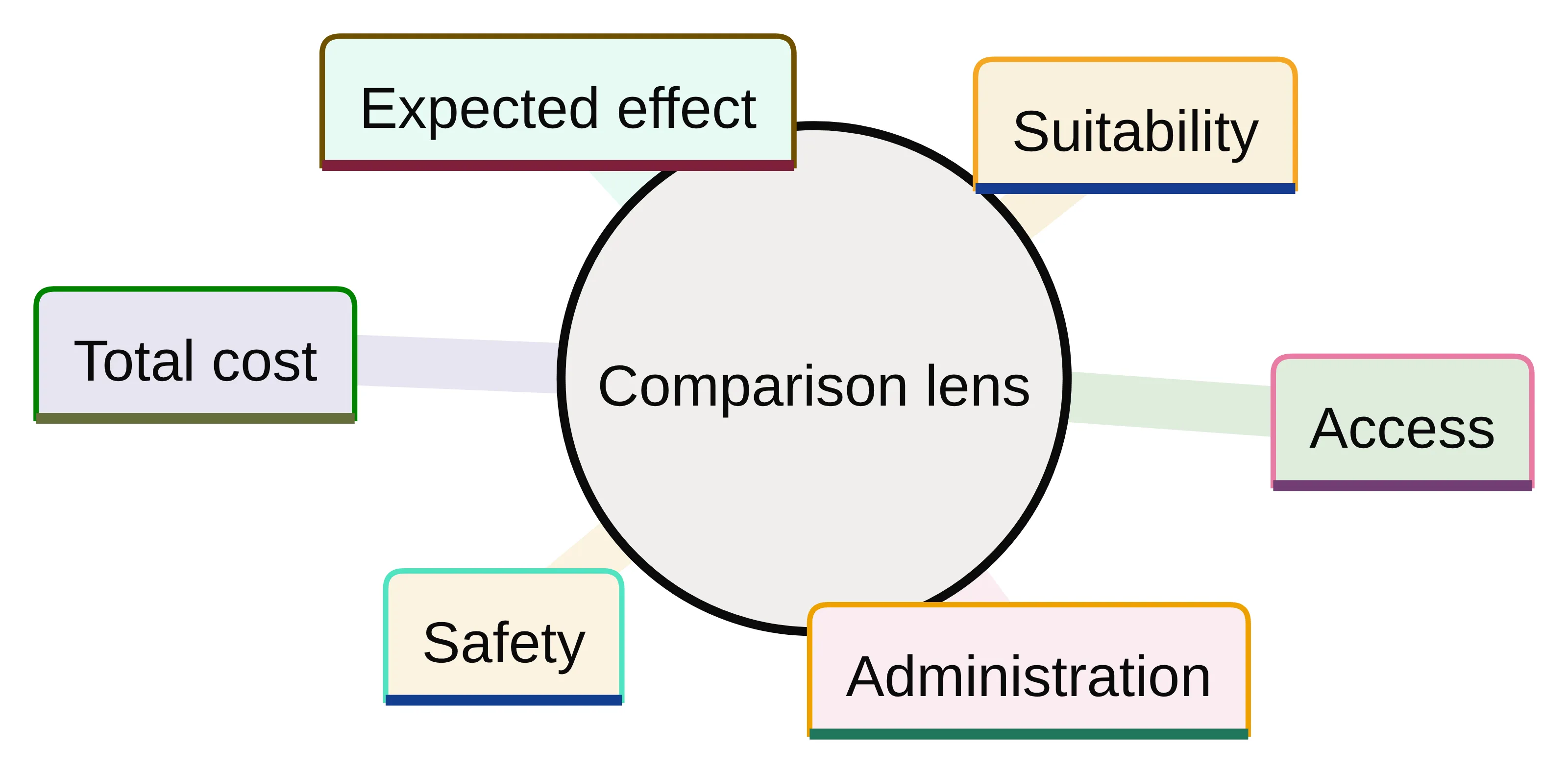
Each criterion answers a different question:
- Expected effect: What benefit does the evidence describe, and how might your overall health affect your response? Treat averages as context, not a forecast.
- Safety: What conditions, allergies, current medicines, supplements, or life circumstances could change the risk discussion?
- Suitability: Do you meet the clinical criteria for considering medication, and does the option address your treatment goals?
- Administration: Is the form a pill or injection, and what schedule or technique would the prescription require?
- Access: Would your insurance or care pathway require prior authorization, step therapy, or another administrative step?
- Total cost: What would you pay for the medication, clinical care, follow-up, and any required access process?
A comparison becomes more useful when every option receives the same questions.
You can turn the lens into a short worksheet before an appointment. Create one row for each option under discussion, then add columns for the six criteria. Leave uncertain cells blank rather than guessing. Mark each item as known, needs clinician review, or needs cost or coverage confirmation. Add a final column for the question you need answered before moving forward. The worksheet organizes your discussion; it does not determine eligibility, predict results, or replace a prescription decision.
Use the worksheet as a decision record rather than a scorecard. Begin by separating questions that need clinician review from preferences that can be weighed after that review. Current medicines, allergies, pregnancy or breastfeeding, and relevant health conditions belong in the clinical discussion. Do not treat an unresolved safety or suitability question as something that can be balanced away by a lower cost, easier route, or preferred schedule. Mark it as unresolved and carry it forward.
Next, separate evidence questions from personal-fit questions. Record what the available evidence measures, while noting that most options have not been compared directly and that individual responses can vary. Then record what depends on your circumstances, such as related health conditions, prior treatment experience, preferences, access, and budget. This prevents an average treatment effect from becoming a personal prediction.
Finally, use the practical columns to test whether a proposed plan could be started and continued. Confirm the route and schedule with the clinician, check coverage and administrative requirements with the insurer or provider, and write down follow-up questions about response, side effects, and changing circumstances. A completed row should therefore show three things: what is known, what requires clinical judgment, and what requires confirmation from the provider or insurer. The value of the worksheet is not a winning score; it is a clearer record of the questions that must be answered before you choose a care pathway.
Keep three types of information separate while you compare options. A study or guideline can describe an average treatment effect. Your health history can change whether that option is suitable. Your coverage and routine can determine whether you can start and continue it. When those categories are mixed together, a promising result can look like a personal guarantee or a low starting price can look like a complete treatment budget.
Compare oral and injectable routes without assuming one fits everyone
Oral and injectable routes create different practical questions, but neither route is automatically the right fit. Weight-management guidance treats form, dosing frequency, interactions, side effects, expected effect, and cost as shared decision criteria. The route comparison below keeps those questions visible without assigning a preference to either form.
| Comparison point | Oral route | Injectable route |
|---|---|---|
| Administration | Ask how the prescription is taken and what schedule applies. | Ask how the prescription is administered, what schedule applies, and what technique or supplies are needed. |
| Health review | Review conditions, allergies, pregnancy or breastfeeding status, current medicines, and supplements. | Review conditions, allergies, pregnancy or breastfeeding status, current medicines, and supplements. |
| Expected effect | Ask what the supporting evidence measures and how your circumstances may affect response. | Ask what the supporting evidence measures and how your circumstances may affect response. |
| Access | Ask whether your plan covers the prescription and whether prior authorization or step therapy applies. | Ask whether your plan covers the prescription and whether prior authorization or step therapy applies. |
| Cost | Calculate medication, visits, follow-up, and any access-related costs. | Calculate medication, visits, follow-up, and any access-related costs. |
| Practical fit | Decide whether the prescribed routine is realistic for your schedule and preferences. | Decide whether the prescribed routine and injection process are realistic for your schedule and preferences. |
The route itself does not settle effectiveness or suitability. Most medications in the cited clinical standard have not been compared directly, and individual responses vary. Ask the clinician to explain the relevant evidence for the specific options under discussion, then decide whether you can manage the prescribed form, schedule, follow-up, and cost. Do not choose an option solely because it is oral or injectable.
Use a route-fit test to make the comparison practical. The purpose is not to rank forms in the abstract, but to identify which questions must be answered before a clinician can evaluate the options together:
- Write down the recurring action. For an oral option, describe the act of taking the prescription as directed. For an injectable option, describe the act of administering it as directed. Keep this description general until a clinician or prescription provides the specific instructions.
- Record the schedule that must be confirmed. Note how often the option would be used, then mark the frequency as unknown if you have not received prescription-specific guidance. Do not infer a schedule from a search result, another person’s experience, or a different medication.
- List technique questions separately. If an injectable option is under discussion, ask what technique, supplies, and instruction belong to that specific prescription. For an oral option, ask what administration instructions apply. These are practical questions, not reasons to assume that one route is safer or more effective for everyone.
- Test the routine against your real week. Consider work, travel, caregiving, changing schedules, and the places where you normally keep medicines. The question is whether you can follow the prescribed routine consistently enough to discuss it honestly with the clinician. If a routine seems difficult, record the barrier rather than silently ruling the option in or out.
- Separate preference from constraint. You may prefer a pill, prefer an injection, or have no route preference. A preference is one part of shared decision-making; it does not establish suitability. A constraint, such as difficulty with a required technique or uncertainty about access, is a reason to ask for another option or a different care process to be reviewed.
- Plan for an interruption without improvising. Ask what instructions apply if you cannot follow the expected routine, miss an administration, or cannot obtain the prescription on time. Do not borrow instructions from another medication or make an unsupervised change. Add the answer to your written plan so the next step is clear.
- Check the support pathway. Ask who can answer route-specific questions, how follow-up will occur, and what to do if the prescribed form becomes impractical. A route comparison is incomplete if it considers the first administration but not the help available afterward.
This test produces a narrower comparison than a general medication scorecard. For each option, record the route, confirmed or unconfirmed schedule, technique questions, routine barriers, access questions, and follow-up contact. Then ask the clinician to connect those practical details with your health information, treatment goals, expected effect, safety considerations, and cost. The record should show what you know, what still needs clinical review, and what requires confirmation from the provider or insurer.
Also confirm time-sensitive details before acting. Current United States approval status, labeling, availability, and pricing should be checked with an appropriate clinician, provider, or insurer rather than inferred from the phrase “weight loss pill.” A route may be easy to describe and still require a separate review of whether the specific medication and intended use fit your circumstances. This keeps administration preference in its proper place: important for feasibility, but not a substitute for clinical assessment.
Check whether medication belongs in your care plan
Medication belongs in a care plan only after a clinician considers your clinical circumstances and treatment goals. The AGA recommendation to add pharmacological treatment applies to adults who meet its stated criteria, including those with a recognized weight-related condition or related complications who have had an inadequate response to lifestyle interventions. The recommendation is not a general instruction to start medication after a search or a single scale measurement.
A clinician-reviewed assessment should connect the treatment question to information that can change the decision:
- What health outcomes matter most to you?
- Do you have related conditions that could affect expected benefit or choice?
- What treatments or lifestyle interventions have you already tried, and what happened?
- Which route, schedule, and degree of clinical contact can you realistically manage?
- Could another medicine, supplement, allergy, or health circumstance change the safety discussion?
- Does your insurance or budget limit the options you can continue?
These questions support a shared discussion. They do not give you an eligibility determination before an examination and assessment.
Long-term planning matters because the AGA says anti-weight-management medications generally may need to be used chronically, while the clinical standard describes medication as being used alongside lifestyle changes rather than as a stand-alone strategy. Ask what continued treatment would involve if an option is prescribed, how progress would be assessed, and what would prompt a change in plan. A treatment you cannot access, afford, administer, or continue needs a different discussion before you commit.
Build the safety screen before discussing a prescription
A medication safety screen starts with your complete health and medication information. Weight-loss medications can interact with prescription drugs, over-the-counter medicines, and herbal products. NIDDK also advises discussing medical conditions that could increase your risk and telling a healthcare professional about allergies or sensitivities. Bring the actual names, strengths, and schedules of your medicines and supplements when possible.
Pregnancy, planned pregnancy, and breastfeeding require an explicit medication discussion before use. NIDDK advises against weight-loss medications during pregnancy because they may harm the fetus and says they are not recommended during breastfeeding. Do not combine a weight-loss medication with another product intended for weight loss unless a healthcare professional prescribes the combination. Raise these boundaries before starting, switching, or adding anything.
Reports of suicidal thoughts or actions exist for certain weight-loss medications, and the FDA has been evaluating whether the medications caused them. Ask the prescribing clinician which warning information applies to the specific option being considered and what contact process applies if concerning symptoms appear. Keep that question in your safety discussion rather than treating a general medication list as complete.
Monitoring should be discussed as part of the prescription conversation. Ask what information the clinician needs before prescribing, which changes you should report, how response and side effects will be reviewed, and when follow-up should occur. General medication information cannot replace a healthcare provider’s examination, assessment, and advice about your circumstances.
Treat follow-up as part of the medication decision
Follow-up is part of the medication decision because treatment may need to continue long term and your response can depend on the medication, your overall health, and other factors. A prescription is not the end of the comparison. Before starting, ask how the clinician will assess whether the option is helping, whether side effects change the plan, and how your treatment goals will be revisited.
A workable follow-up plan should make the next decision clear. Ask:
- What should you track between appointments?
- Which symptoms or medication problems require a prompt message or call?
- When will the clinician review your response and overall health information?
- What happens if access changes or the prescription becomes unaffordable?
- How will the plan address other medicines, supplements, pregnancy plans, or a new diagnosis?
- What is the process for continuing, changing, or stopping treatment?
The exact answers depend on the prescription and your circumstances, so record them in writing rather than relying on memory.
Ongoing support should have a defined purpose. Ask whether follow-up includes medication questions, access problems, side-effect review, progress toward your health goals, and coordination with other care. The Canadian guideline recommends considering expected benefit for related health conditions, side effects, form, dosing frequency, interactions, and cost; follow-up gives you a place to revisit those same criteria as your circumstances change.
Ask what would cause the plan to be continued, reconsidered, or changed. The AGA notes that medication selection depends on your clinical profile, preferences, cost, and access, and that treatment may need to continue long term. That makes follow-up a decision point, not merely a routine check-in. Leave the appointment knowing which information will guide the next conversation.
Calculate access and total cost before committing
Insurance coverage can change the practical comparison as much as the medication itself. Coverage information retrieved in October 2026 indicates that coverage for medications such as Wegovy and Zepbound varies by plan, and many plans do not cover prescriptions used strictly for weight management. Some plans require prior authorization, step therapy, or both; those requirements can delay access and add administrative work.
Total cost includes more than the amount attached to a prescription. Write down each possible cost before comparing options:
- medication cost after insurance or other applicable savings;
- consultation and follow-up costs;
- supplies or administration-related costs, if applicable;
- costs created by prior authorization, step therapy, or a change in coverage;
- the expected cost of continuing treatment if long-term use applies.
Coverage rules and prices can change, so use current plan and provider information when you build the estimate. Do not treat a temporary price, a headline price, or an introductory offer as your ongoing budget.
Ask the clinician or insurer direct access questions:
- Is the medication covered for the relevant use?
- Does the plan require prior authorization or step therapy?
- What documentation is needed?
- What happens if coverage is denied or changes?
- Which costs remain your responsibility?
- Does the quoted amount include clinical visits and follow-up?
These questions do not determine whether a medication is clinically appropriate, but they reveal whether a proposed plan is practical to start and continue.
Bring a clinician-ready question list
A clinician-ready question list turns a broad medication search into a focused appointment. Before the visit, add your current medicines, supplements, allergies, relevant health conditions, pregnancy or breastfeeding status, prior treatment experience, preferred route, and budget. A complete starting record helps keep the safety and access discussion connected to the medication comparison.
Clinical fit
- Do my health information and treatment history support discussing medication?
- What goals should guide the decision?
- Which related health conditions could affect the choice?
Comparison
- What does the evidence measure for each option under consideration?
- How should I interpret expected effect without treating it as a personal prediction?
- What side effects, interactions, or warnings matter for me?
Administration and follow-up
- Is an oral or injectable route more practical for my circumstances?
- What schedule, technique, and follow-up process would apply?
- Which symptoms or changes should I report promptly?
- How would the plan be continued, changed, or stopped?
Access and cost
- Does my insurance cover the medication for the relevant use?
- Could prior authorization or step therapy delay access?
- What will the medication, visits, follow-up, and administration cost over time?
Support
- Who handles medication questions between visits?
- How will ongoing support connect with my health goals and other care?
Your medication and supplement record is an important part of the appointment. Include prescription medicines, over-the-counter products, herbal products, allergies, sensitivities, and changes since your last visit. General information can help you prepare, but a healthcare provider still needs to assess your circumstances before a treatment decision.
Use personalized telehealth care as the next-step option
Telehealth is a care setting, not a substitute for clinical assessment. Ask how the care pathway handles your health history, current medicines, allergies, pregnancy or breastfeeding status, prescription decisions, follow-up, and changes that require in-person care. Ask how pricing is presented and how ongoing support works. Those details help you judge whether the pathway can address the questions that matter before and after a prescription discussion.
Keep medication questions tied to your health history and practical circumstances rather than arriving with a medication name alone. A focused list can help you organize a clinician conversation.
Request a personalized health assessment
A sensible next step is to take your comparison worksheet, medication list, health questions, route preference, and cost concerns to a qualified healthcare professional. General medication information cannot replace an examination, assessment, and advice about your circumstances, and a qualified professional must decide whether a treatment is suitable for you. Use the discussion to identify the option, care pathway, and follow-up plan that can be evaluated together.
Questions to ask before choosing a weight-management medication
What should I consider when comparing weight loss medications?
When comparing weight loss medications, consider factors such as expected effectiveness, safety, suitability for your health conditions, administration method (oral vs. injectable), access through insurance, and total cost including follow-up care.
How do I know if a weight loss medication is suitable for me?
Suitability for a weight loss medication depends on your health profile, including any existing conditions, allergies, and current medications. A clinician can help determine if a specific medication aligns with your treatment goals.
How does insurance coverage affect access to weight loss medications?
Insurance coverage for weight loss medications varies by plan. Some plans may require prior authorization or have restrictions, which can affect your access and out-of-pocket costs.
What questions should I ask my clinician about weight loss medications?
You should ask about the expected effects, side effects, administration method, costs, insurance coverage, and what follow-up will look like. It’s also important to discuss how the medication fits into your overall health plan.